
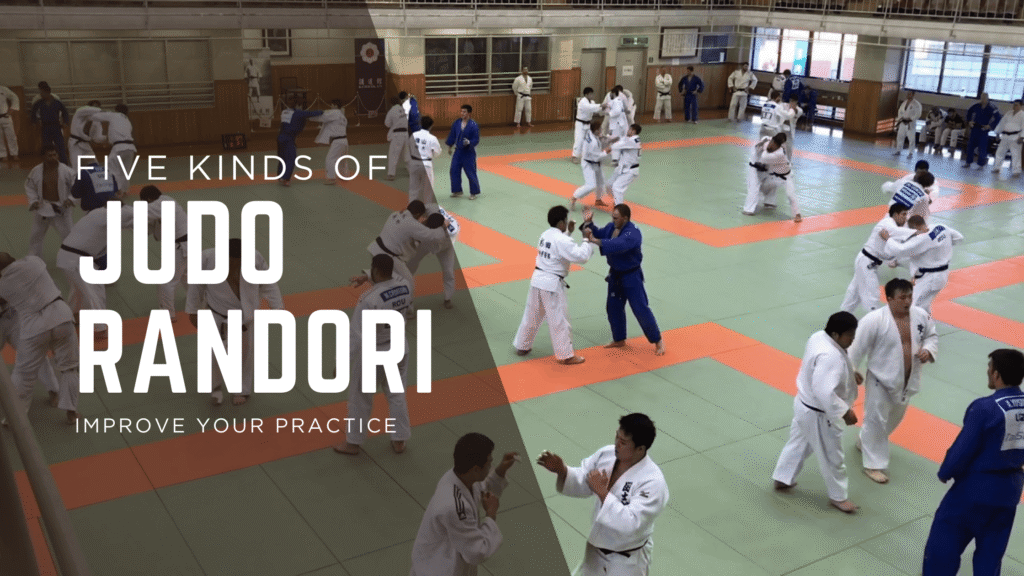
Randori is free practice – typically 2-5 minute rounds where you can try any technique you like against a resisting opponent. In boxing it’s called sparring, in wrestling it’s “going live,” and in jiujitsu it’s called “rolling.”
There are five main types of randori. Here’s a quick breakdown.
- The Kuzushi Game. In this type of randori, there are lots of limitations. You and your partner start with standard sleeve and lapel grips, which can’t be changed. Your objective is to get your partner on the floor and stay on your feet, but there are no “throws” allowed per se – no hip tosses, no shoulder throws, no foot sweeps. So what can you do? You can push them, pull them, spin them in a circle, twist them around, whatever you can do without doing standard throw movements. This is a great exercise for beginners: it gives you a real taste of what high intensity judo randori feels like, without the danger of getting yeeted by a high amplitude judo throw that you might not be prepared for.
- Trading Throws. You throw, I throw, you throw, I throw, with full cooperation and no resistance. So what makes this different from just practicing throws (aka nage komi)? Movement. Randori is all about movement – when it’s your turn to throw, start moving your partner around, forwards, backwards, in a circle. Drag them over to a particular corner of the mat, and if your partner understands the purpose of the drill, they will come with you and allow you to move them wherever you want. Then try to throw them while you’re in motion. Very important: remember that it’s practice for both partners. The thrower (tori) is practicing throwing, and the throwee (the uke) is practicing going with the motion of the throw and taking falls safely.
- Offense / Defense. In this kind of randori, you and a partner trade the roles of offense and defense. For two minutes, one partner does offense only, while the other does defense only. Then for the next two minutes, the roles are switched. Now, it’s important to note what good judo defense is. Offense is conceptually easy – just attack and keep attacking, find an opening, go for a throw. Judo defense, done properly, puts you in a good position to counter attack while at the same time avoiding what could be an obvious penalty in competition – for instance, just bending at the waist and refusing to engage is not good defense.
- Grip Fighting Only (Kumikata). Just what it sounds like. You fight for a dominant grip and make an entry but don’t complete the throw. Grip fighting in judo means getting your preferred grip while forcing your opponent to accept an inferior grip, and then quickly using that advantage to enter for a throw.
- Regular Randori. This is the broadest type of randori, where the most different type of techniques and approaches are allowed. You and your partner try to throw each other while not getting thrown yourself. Within this category there are several different approaches, let’s quickly go over them.
– Throws only: no ground work (newaza). After a throw, you get up and reset.
– With transitions to newaza. After or during a throw, you look for an opportunity to continue directly into a pin, choke, or armbar. Typically you spend no more than 20-30 seconds securing a position in newaza before resetting on the feet
– “Going light” – both players are attacking and defending but not defending too hard.
– “Going hard” – just what it sounds like. Both players try to dominate the round in all aspects: gripping, throwing, and transitions to newaza.
If you’re in Central Texas, come practice with us at Waco Judo!