Judo is both a martial art and a sport. Today we’re concerned with judo as a sport. Every sport has rules and some sort of scoring system, so what are the judo competition rules? How do you win?
This guide will be useful for judo beginners as well as jiujitsu players interested in learning more about judo competitions. Please keep in mind that rules are constantly being tweaked by the International Judo Federation, and this information is current as of November 2025. For the latest rules, check the IJF Sport and Organization Rules website (PDF).
SCORING
- Ippon – ends the match. Every player is going for ippon.
- Wazari – half an ippon. Two wazari add up to an ippon and will end the match.
- Yuko – a minor score used as a tiebreaker in low scoring matches. Yuko are not cumulative (they don’t add up to anything) and are always outranked by a wazari or ippon. If you have 3 yuko scores and your opponent has 1 wazari at the end of regulation, you lose.
how to Score
There are four ways to earn a score in a judo match.
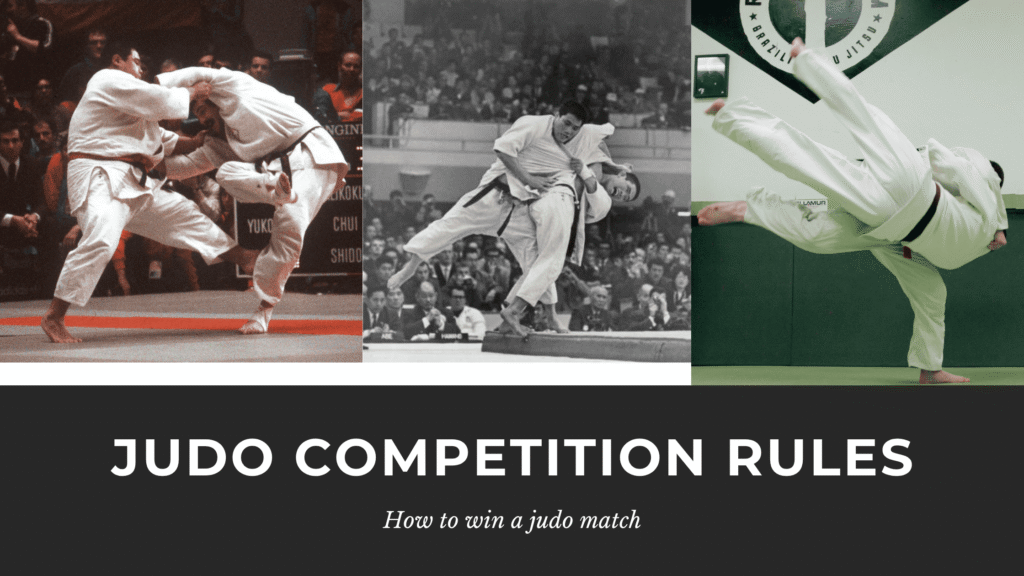
- Throw (Nage Waza) – if you make one big throw and land your opponent flat or mostly on their back with force and control, the referee will award an ippon score and the match is over. A throw that is pretty good but not quite an ippon will earn a wazari, and a throw that only sort of knocks your opponent on their butt will earn a yuko.
- Pin (Osaekomi waza) – hold your opponent down for twenty seconds and the referee will award ippon and the match is over. If you hold the pin for 10-19 seconds before they escape, you earn a wazari. 5-9 seconds earns a yuko.
- Choking/Strangling technique (Shime Waza) – Make your opponent tap and the referee will award ippon. There are no wazari or yuko scores given for attempted or unsuccessful chokes. Most lapel chokes are allowed, as well as the triangle (sankaku jime) and the rear naked choke (hadaka jime). Guillotine type chokes are not allowed, and when a lapel or arm is over the chin as part of the choke, that is considered unsafe and the referee will call matte (stop) and the player will reset on the feet.
- Joint Lock technique (Kansetsu Waza) – Make your opponent tap and the referee will award ippon. There are no wazari or yuko scores given for attempted or unsuccessful joint locks. Players are only allowed to attempt joint locks against the elbow joint. All types of straight arm bars (juji gatame) are allowed as well as kimura and americana type joint locks (ude garami).
Penalties
Penalties in judo are called shido. Three shido equals hansokumake, which is an automatic disqualification and a win for the opposing player. The referee also has the option to award hansokumake directly for flagrant fouls or “actions against the spirit of judo,” which basically means very bad sportsmanship, excessive celebrating, intentional hitting or kicking, biting, crazy stuff like that.
We won’t go over all the penalties, but basically they want to see “positive judo,” which means a lot of attacks, a lot of legitimate throw attempts. Ultimately the scoring and penalty system encourages lots of fast attacks and punishes defensiveness.